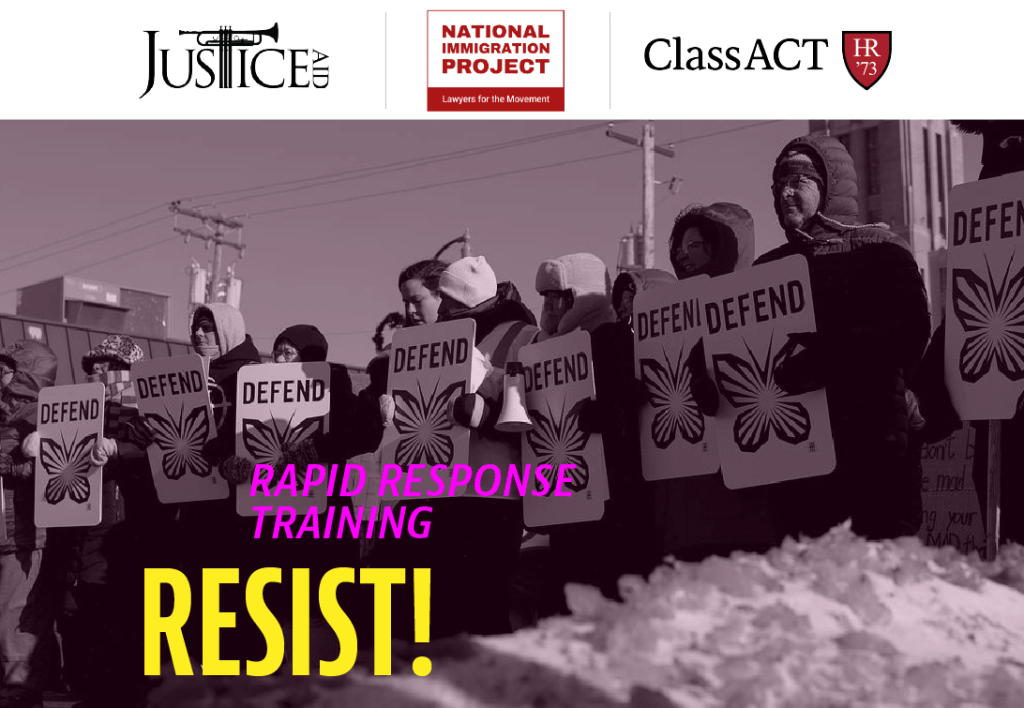
What does “Rapid Response” entail in this current environment, and what can each of us do should ICE or CBP come to our community? Listen to this free virtual training on your rights vs. the realities of immigration enforcement, facilitated this month by JusticeAid’s 2026 grantee partner, the National Immigration Project.
“Rapid response is very localized… and is more successful when people work in collaboration rather than isolation.”
—Gracie Willis, National Immigration Project Coordinating Attorney
SUMMARY & ACTIONS YOU CAN TAKE
Sirine Shebaya, Executive Director of the National Immigration Project, outlined the dramatic increase in arrests, both in public, as well as at previously protected locations such as schools, churches, hospitals, immigration court check-ins, and hearings.
Rapid Response is shorthand for a number of actions that people can take after—and sometimes before—community members are arrested by DHS (ICE or CBP).
Non-Attorneys can make use of this rapid response spreadsheet and your own local knowledge to connect within your community’s local Rapid Response team: Answer phone hotlines, do translation or interpretation, record or keep data, ICE watch—show up and bear witness to an action through video and narrative recording, and accompany people at risk to doctors’ appointments, school drop-offs, and immigration hearings.
Attorneys can sign up here for Habeas Projects. The National Immigration Project is partnering with local groups in different parts of the country (including Louisiana & Southeast region, DC/Maryland/Virginia, Minnesota, New Mexico, and Texas) to set up habeas referral pipelines, place habeas cases, and train and mentor attorneys to deepen the bench of available representation.
Pitch in today.
Your donation to JusticeAid will support the National Immigration Project commitment to help those most vulnerable to detention and deportation.

Join the family.
Read up on JusticeAid events and our support for the National Immigration Project.