Art often reflects the mores and social issues of a community, a culture, a country. In this May/June edition of Justice + Art, we turn to dance as a medium of resistance, and highlight dance companies shining their light on the struggle of immigrants, whether forced or voluntary, over the centuries and around the world.
Rhiannon Giddens
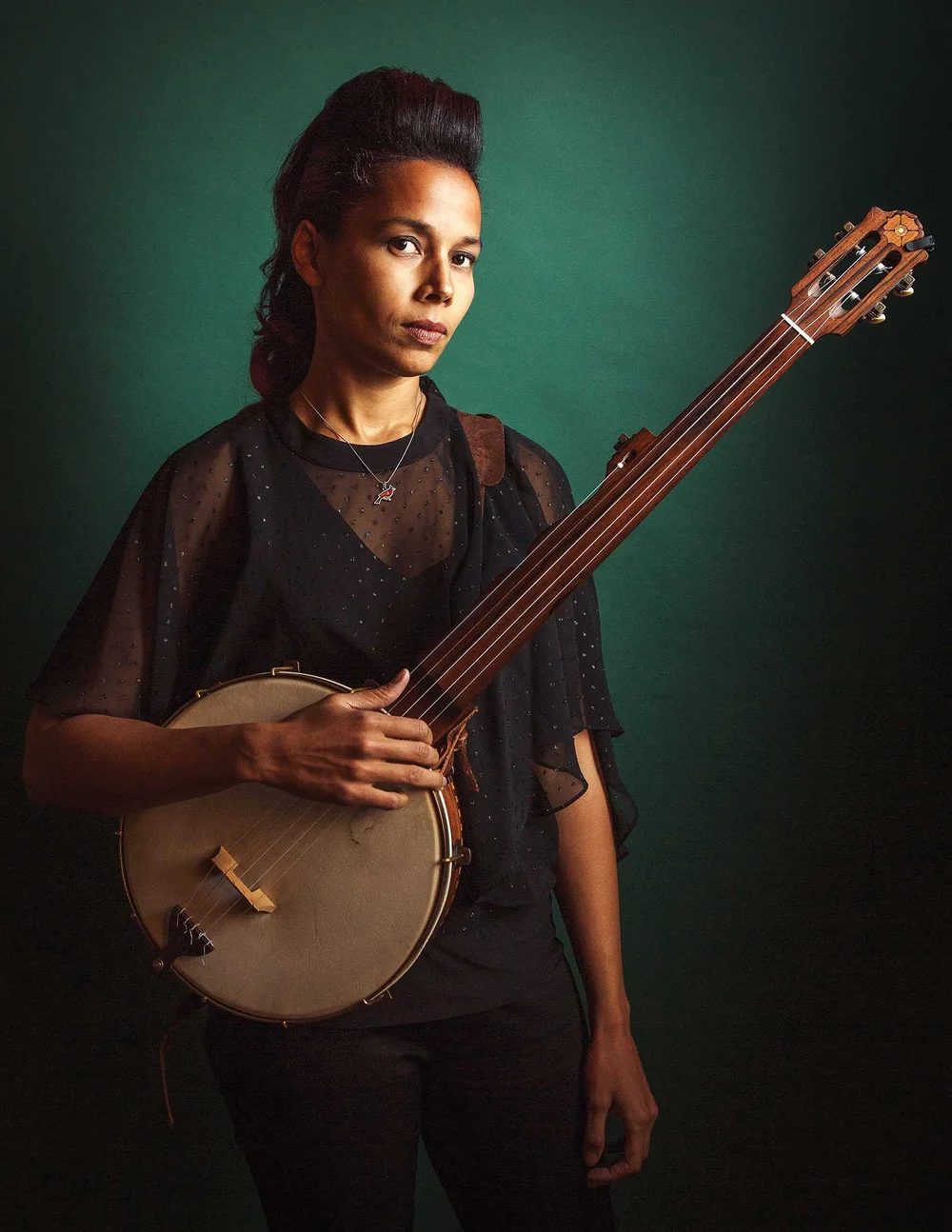
Rhiannon Giddens has made a singular, iconic career out of stretching her brand of folk music, with its miles-deep historical roots and contemporary sensibilities, into just about every field imaginable. A two-time GRAMMY Award-winning singer and multi-instrumentalist, MacArthur “Genius” grant recipient, Pulitzer Prize winner, and composer of opera, ballet, and film, Giddens has centered her work around the mission of lifting up people whose contributions to American musical history have previously been overlooked or erased, and advocating for a more accurate understanding of the country’s musical origins through art.
Music
Rhiannon sings and plays fiddle, but she’s probably most known for playing an 1858 replica of the banjo derived from an African gourd instrument brought to the Americas via the transatlantic slave trade.
Growing up in the North Carolina Piedmont, the daughter of mixed race parents, Givens spent her Saturday nights watching Roy Clark and his country show Hee Haw. His lightning-fast solos sparked her love for the banjo, but the tradition always felt rather white. Later, after studying opera at Oberlin Conservatory, Givens discovered the long, almost forgotten line of traditional black string bands. She learned to play banjo and bluegrass fiddle and formed a trio that eventually became the Carolina Chocolate Drops—the first black string band to perform on the Grand Ole Opry.
More recently, Givens brought this history to millions by playing the opening lines on Beyoncé’s “Texas Hold ‘Em,” proving that American music was built on Black innovation. Pitchfork describes Giddens as “fearless” because she refuses to let these legacies stay buried.
Theater
Giddens took her mission all the way to the grand opera house to challenge old traditions. She co-wrote the Pulitzer Prize-winning opera Omar, which tells the incredible true story of Omar Ibn Said. He was a wealthy Islamic scholar from West Africa who was stolen, enslaved in North Carolina, and left behind an autobiography written entirely in Arabic. By blending West African roots, Muslim prayers, and slave narratives into a grand opera, Giddens gives a beautiful voice to someone history tried to make anonymous.
(include?) Standard history books often reduce enslaved people to just nameless manual laborers, stripping away their minds and identities. Omar completely flips that script. The production shows that early America was deeply shaped by brilliant, highly educated global citizens. Giddens uses the drama of the opera stage to demand an honest look at our origins, making sure these stolen intellectuals are finally written back into the American story.
Handicrafts